
Manaslu Region
Manaslu Base Camp Trek
17 Days/16 Nights
Group Size N/A
Price From

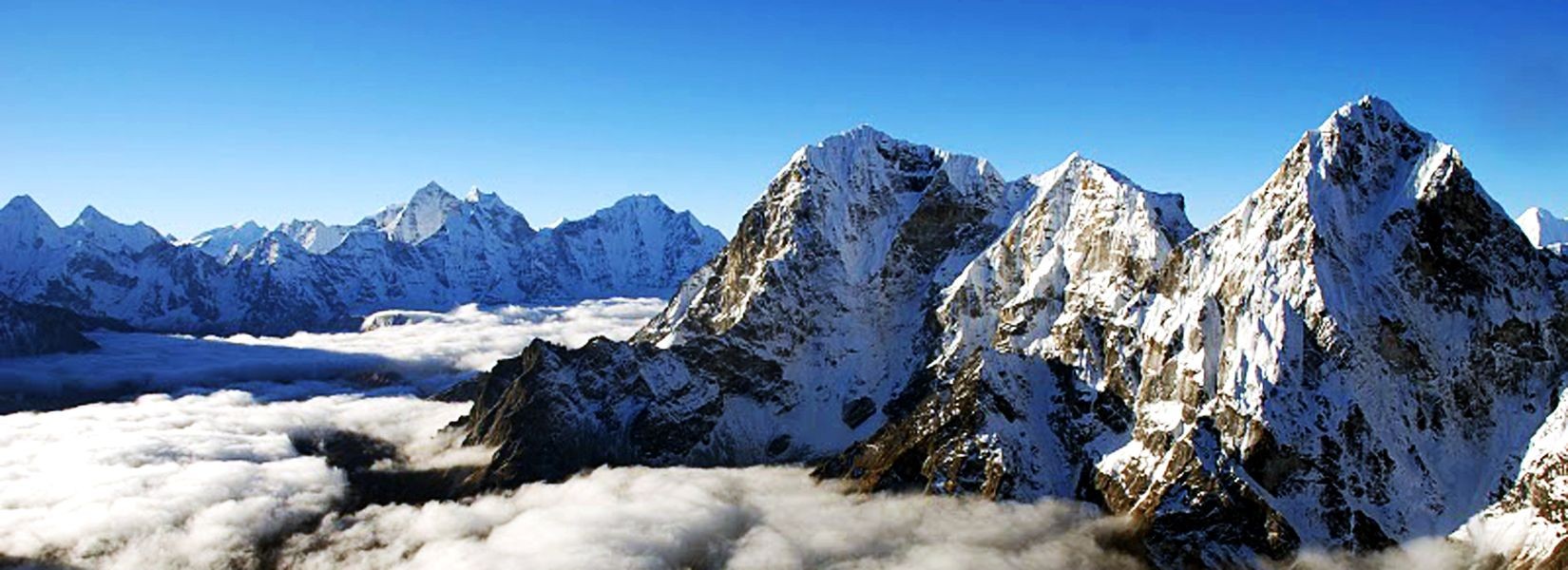
Lobuche Peak climbing is a guided high alpine Himalayan journey that lets you do two legendary bucket list things in one trip: first, you touch Everest Base Camp, and then summit a real Himalayan peak of 6,119m. The peak of Mount Lobuche welcomes you with 4 out of the 10 highest mountains on earth of more than 8,000m, and then 16 other Himalayan giants, which have been there for millions of years. This is standing at the doorstep of something sacred, a higher frequency zone. Mount Lobuche is also known as beginner friendly Himalayan peak for climbing. You’re walking where legendary climbers and Edmund Hillary walked. Our professional expedition team handles everything: meals, oxygen, tents, logistics, and every other thing, for your comfort and safety. What you bring is the willingness to push yourself. No rushing. Just steady progress toward a million-dollar summit experience.
The trail to Lobuche peak is where you enter a different realm of the Himalayas, feels like you’re levitating. You walk beyond the clouds. Your Lobuche peak climbing journey starts through Khumbu’s old-school Sherpa villages’ and high rolling valleys, from the base camp of the world’s highest mountain to the no human settlement zone of the Himalayas. The peak itself rises from an ancient glacial moraine. Geographically, Lobuche splits into two sections: East and West. East is the popular one. More accessible. Better established route. West requires technical expertise that most beginners don’t have. The whole massif sits inside Sagarmatha National Park. UNESCO World Heritage Site. Acclimatization days are carefully placed so your body adjusts naturally. You get local experienced Sherpa guides who grew up in the Everest region. They handle the technical sections. Fixed ropes secure the steeper parts. The experience rewards you with something money can’t buy anywhere else on Earth.
Lobuche Peak climbing is for souls hungry for something real. The climb is less technical than many peaks, yet the altitude is fully serious. And the views? You will be surrounded by a ring of the world’s highest mountains, neighbors of Everest. Mount Lobuche is higher than the entire peaks of Europe. You will enjoy the tea house accommodations and camping accommodations vibes while climbing lobuche peak. Everest, the king of all mountains, dominates the northern horizon. Views of the magnificent Everest on the North Side, with her peak rising from ancient glacial debris.
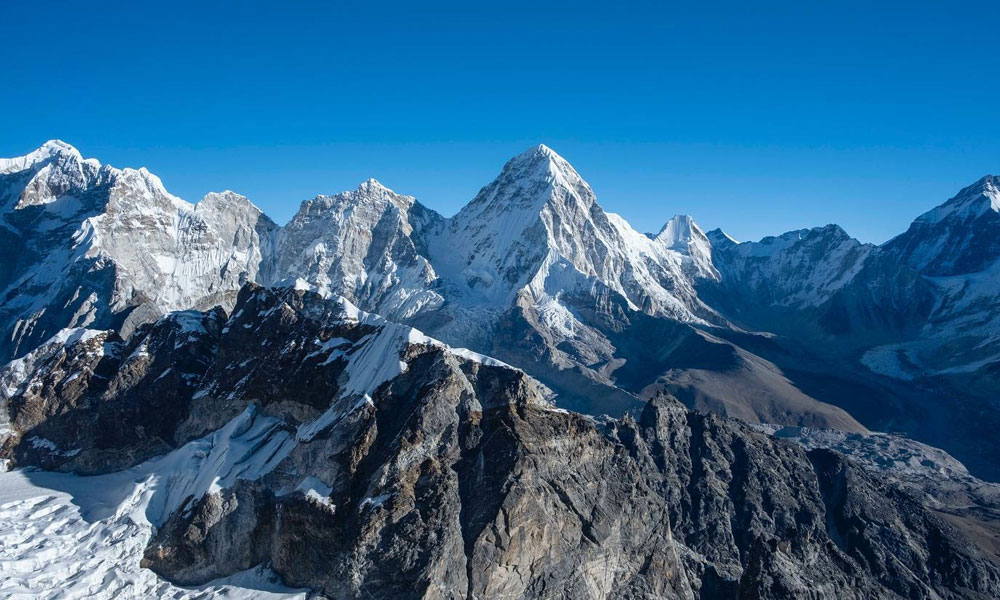
You get 360 panoramic views of 4 peaks above 8000+m; Mount Everest ( 8,848.86 m), Lhotse (8,516 m), Makalu (8,485 m), Cho Oyu (8,188 m), another 4 peaks of 7,000–7,999 m; Nuptse (7,861 m), Changtse (7,543 m), Pumori 7,161 m), Baruntse (7,129 m) and more than 11 peaks of 6000–6,999 m; Ama Dablam (6,812 m), Kangtega (6,782 m), Lingtren (6,749 m), Khumbutse (6,663 m), Thamserku (6,623 m), Taboche (6,495 m), Kusum Kanguru (6,367 m) and many more in Lobuche Peak climbing via EBC-19 days. This isn’t just a climb. It’s total immersion into a highland of a Himalayan wonderland.
What would you do if you could enter a different dimension of the high Himalayas, Lobuche peak climbing at 6,119 meters, where no human lives, and higher frequencies surround you with 360-degree alpine views of more than 21 peaks of 6000-8000m+?
Upon your arrival at Tribhuvan International Airport in Kathmandu, you will be greeted by our experienced expedition team. After the warm welcome, we will transfer you to your hotel, where you can rest and recover from your journey. This day is designed to help you adjust to the new time zone and begin soaking in the vibrant culture of Nepal. If time permits, you may explore the bustling streets of Kathmandu, where you can get a glimpse of the lively markets, ancient temples, and the vibrant energy of this city. This is the start of your unforgettable adventure, and the rest of the day will be at your leisure to unwind and prepare for the exciting days ahead.
After breakfast, we will embark on a guided sightseeing tour of Kathmandu, where you’ll visit UNESCO World Heritage sites that showcase the rich history and culture of the region. First, we’ll visit the Swayambhunath Stupa, also known as the Monkey Temple, which offers a panoramic view of the Kathmandu Valley. Then, we head to the Pashupatinath Temple, a sacred Hindu pilgrimage site on the banks of the Bagmati River. Following this, we explore the Boudhanath Stupa, one of the largest Buddhist stupas in the world. The tour concludes with a visit to Kathmandu Durbar Square, where you’ll admire ancient palaces and temples that reflect Nepal’s royal heritage. In the afternoon, we conduct a pre-expedition briefing and gear check to ensure that all your equipment is in top shape for the trek ahead. This preparation will also include finalizing the details of your expedition and reviewing important information regarding your safety and well-being.
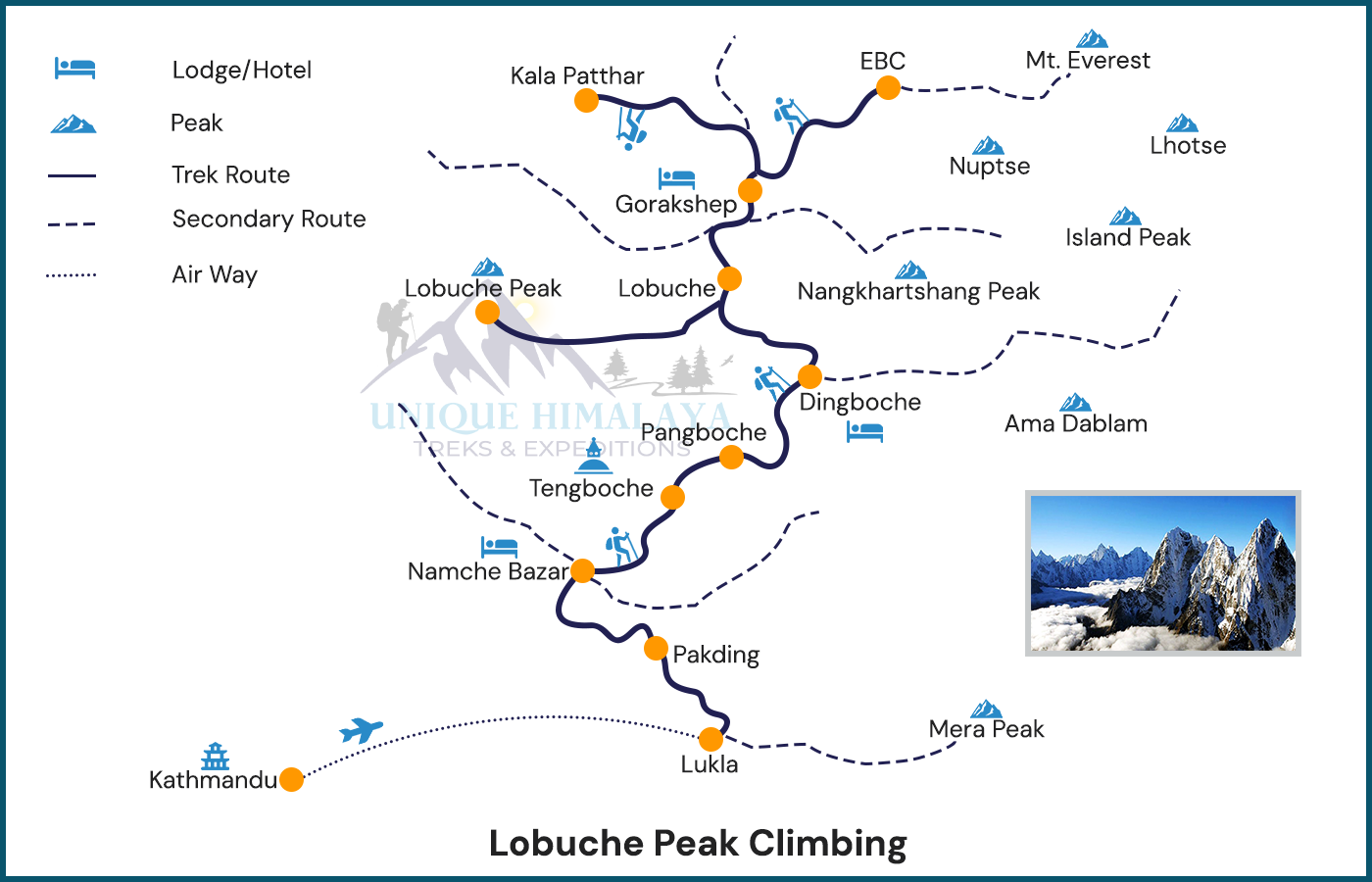
This morning, you will take an early flight from Kathmandu to Lukla, a thrilling experience as you fly over the stunning Himalayan range, arriving at the tiny but picturesque Lukla Airport. Upon arrival, we will meet the rest of our trekking crew and begin our journey towards Phakding, a scenic Sherpa village. The trek follows the Dudh Koshi River, and along the way, we pass through lush forests, serene prayer wheels, and traditional Sherpa villages, immersing ourselves in the unique culture of the region. The beauty of the landscapes and the friendly locals make this a great introduction to the trekking adventure that lies ahead. After a gradual descent, we will reach Phakding, where we will settle in for the night and rest.
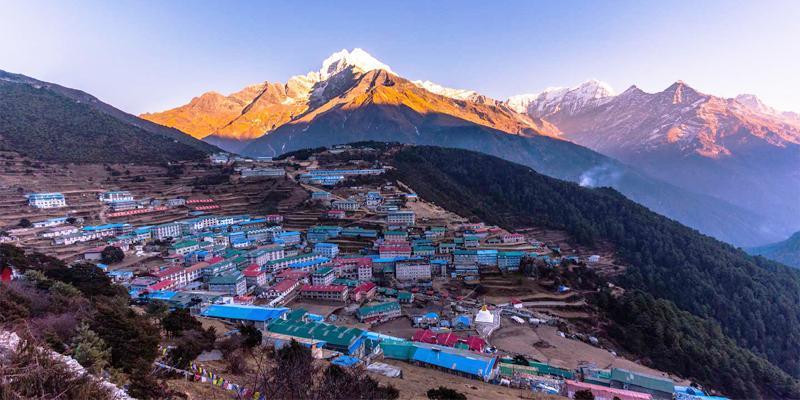
Today, the trek takes us from Phakding to Namche Bazaar, a significant highlight of the journey. The trek is challenging yet rewarding, with several steep ascents and high suspension bridges, offering breathtaking views of the snow-capped peaks along the way. We enter Sagarmatha National Park, a UNESCO World Heritage Site, and continue along trails dotted with prayer flags and stone stupas. As we make our way through forests of rhododendron and pine, the first glimpses of Mount Everest and Lhotse appear on the horizon. Upon arrival in Namche Bazaar, we are welcomed by the vibrant Sherpa town, which serves as the commercial hub of the Khumbu region. After settling into our lodgings, you’ll have time to explore the local markets, interact with the Sherpa people, and enjoy the vibrant atmosphere of this bustling town.
Since we are gaining altitude, today is dedicated to acclimatization, which is crucial for adjusting to the thinning air. Namche Bazaar is the perfect place for rest and exploration. You have the option to hike to Everest View Hotel for stunning panoramic views of Mount Everest and other surrounding peaks, or you can visit the Khumjung village, known for its rich Sherpa culture. Alternatively, you can relax in Namche Bazaar, explore the local markets, taste the delicious food in the cafes and bakeries, or visit the Sherpa museum to learn more about the history and culture of the region. This day of rest helps your body adjust and prepares you for the higher altitudes in the coming days.
The trek today takes us from Namche Bazaar to Tengboche, home to the famous Tengboche Monastery, one of the most important Buddhist monasteries in the Khumbu region. The trail descends through dense forests of pine and rhododendron, crosses suspension bridges, and passes the charming villages of Phunki Tenga. As we approach Tengboche, the landscape opens up to reveal magnificent views of Everest, Lhotse, and the stunning Ama Dablam. Once in Tengboche, we’ll visit the monastery, where you can observe the spiritual rituals and learn about the importance of Buddhism in the lives of the Sherpa people. Afterward, we settle in for the night, surrounded by the tranquility of the Himalayan wilderness.
Today’s trek takes us from Tengboche to Dingboche, a traditional Sherpa village that sits in the heart of the Khumbu Valley. As we trek along the Imja River valley, we are treated to awe-inspiring views of some of the highest peaks in the world, including Lhotse and Island Peak. The landscape gradually changes as we ascend, with lush vegetation giving way to the barren, windswept terrain typical of higher altitudes. Upon reaching Dingboche, we settle into this peaceful settlement and enjoy the views of the towering peaks around us. This village will serve as a great base for acclimatization as we prepare for the next leg of our journey.
Another crucial acclimatization day is scheduled in Dingboche to help our bodies adjust to the high altitude. You can take a short hike to Nangkartshang Peak, which offers panoramic views of Makalu, Lhotse, and Ama Dablam. This will give you a chance to further acclimatize while enjoying some of the most breathtaking mountain scenery in the world. Afterward, you can rest in Dingboche village, visit the local shops, or interact with the friendly villagers. This day of rest ensures that you are fully prepared for the more strenuous parts of the trek ahead.
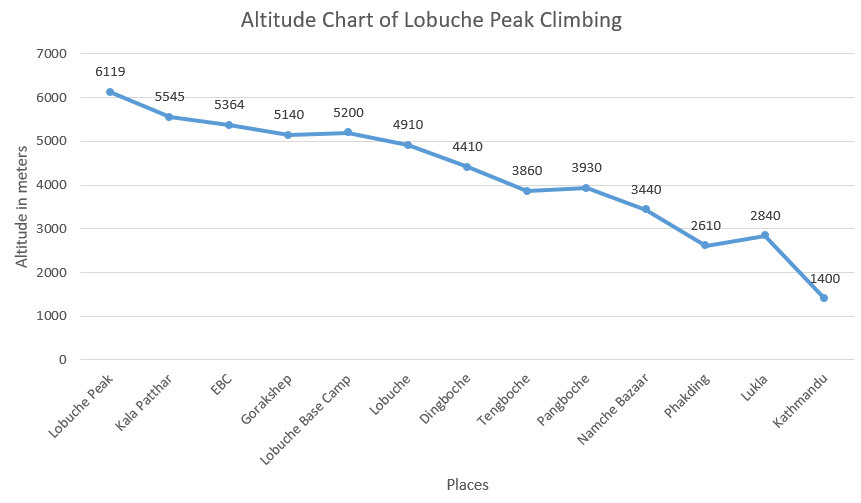
The trek today takes us to Lobuche, located at an elevation of 4,910 meters. As we make our way from Dingboche, we cross the Khumbu Khola and begin our gradual ascent. Along the way, we pass several memorials dedicated to climbers who have lost their lives in the region. The landscape becomes increasingly barren, with sweeping views of Nuptse and Pumori on the horizon. After a steady climb, we will reach Lobuche, a quiet settlement nestled among the towering peaks. The views from Lobuche are breathtaking, offering a glimpse of what lies ahead as we continue towards Everest Base Camp.
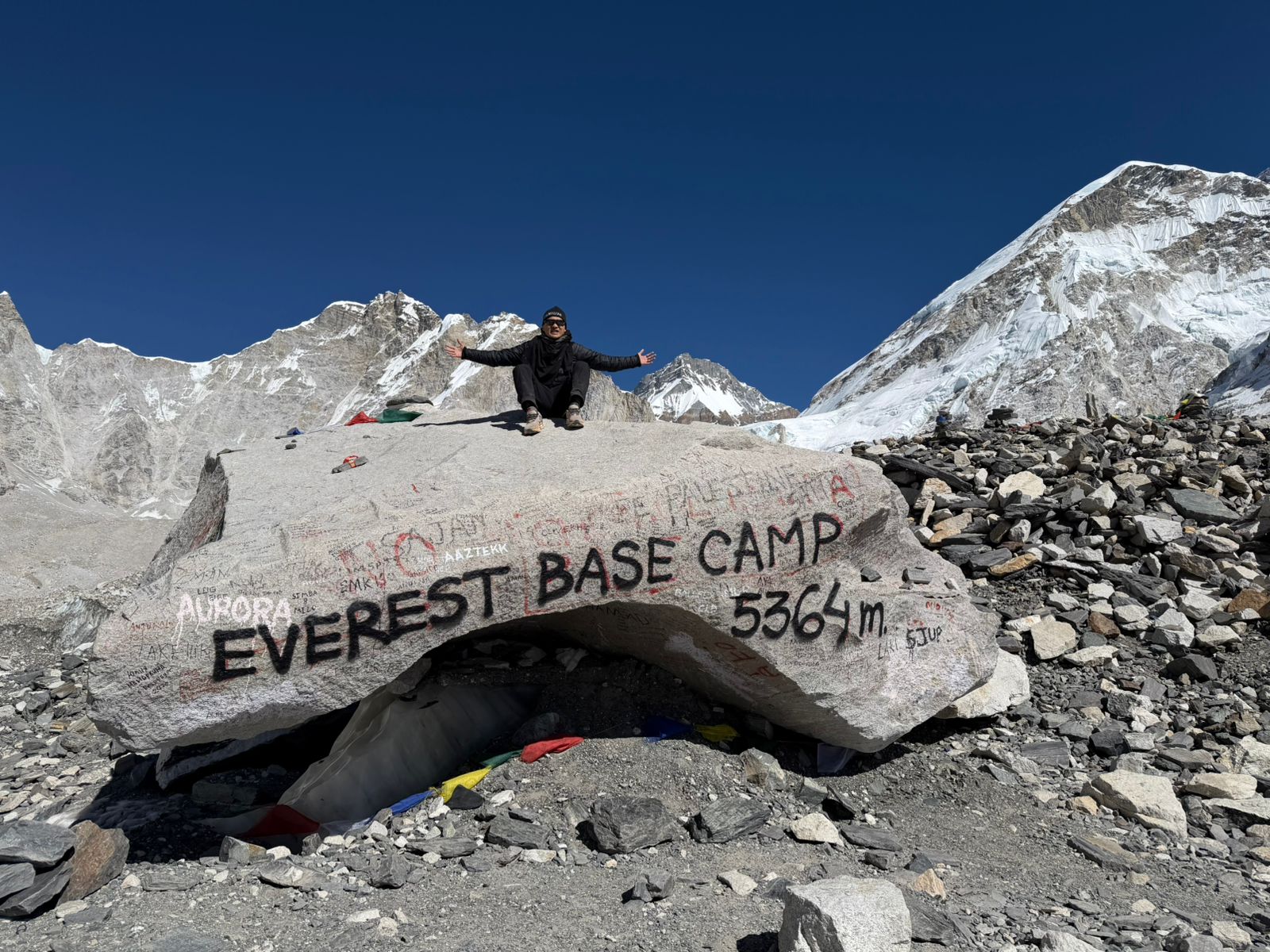
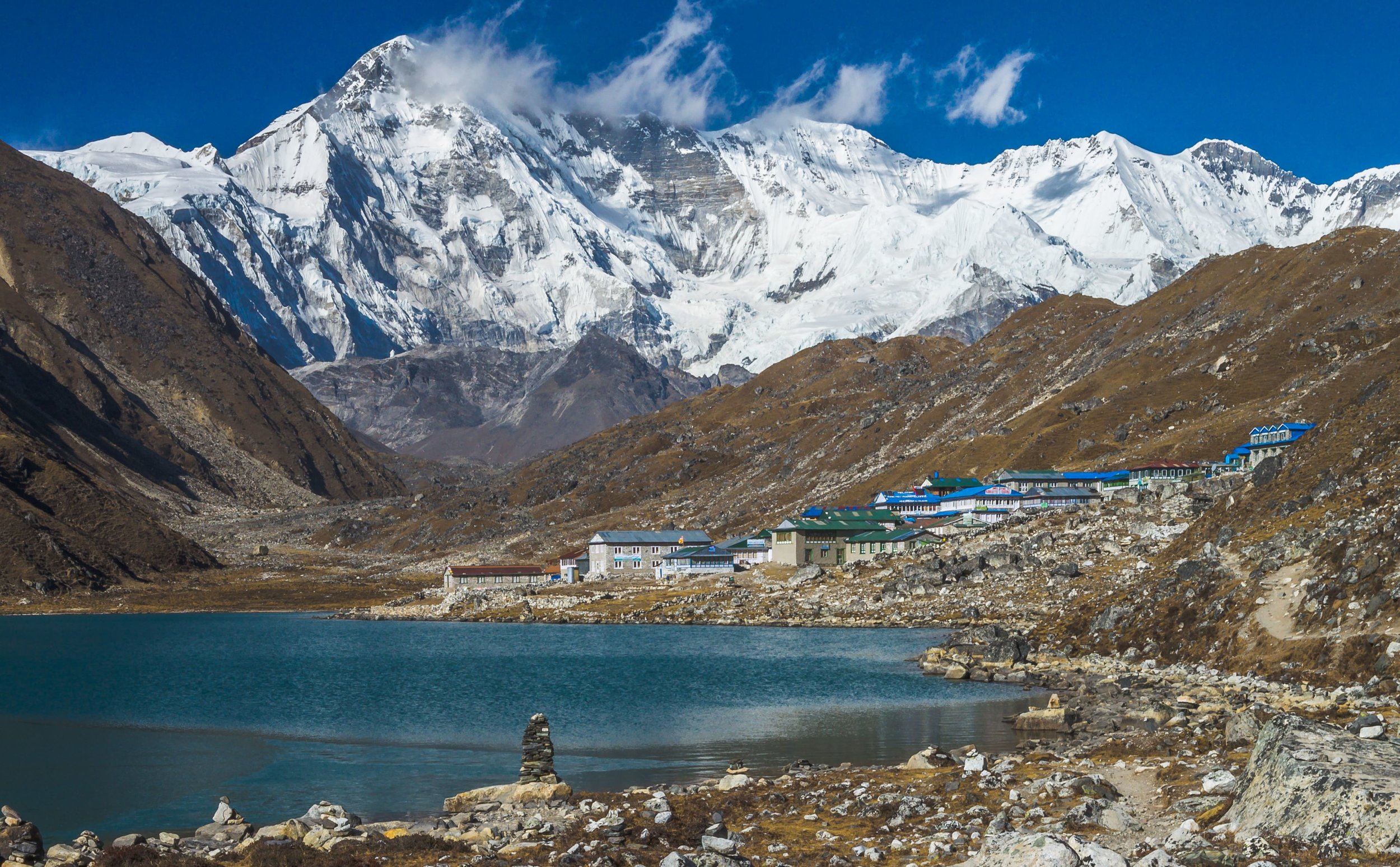
Today is one of the most exciting days of the trek, as we make our way from Lobuche to Gorak Shep, the final settlement before Everest Base Camp. Once we arrive at Gorak Shep, we’ll continue the journey to Everest Base Camp, which is an iconic destination for trekkers and climbers alike. The path to Everest Base Camp traverses the Khumbu Glacier, offering up-close views of the rugged terrain and the awe-inspiring Khumbu Icefall. Reaching Base Camp is a momentous occasion, as it marks the culmination of the trek to one of the most famous and revered locations in the world. After taking in the views and capturing memories, we’ll return to Gorak Shep for the night.
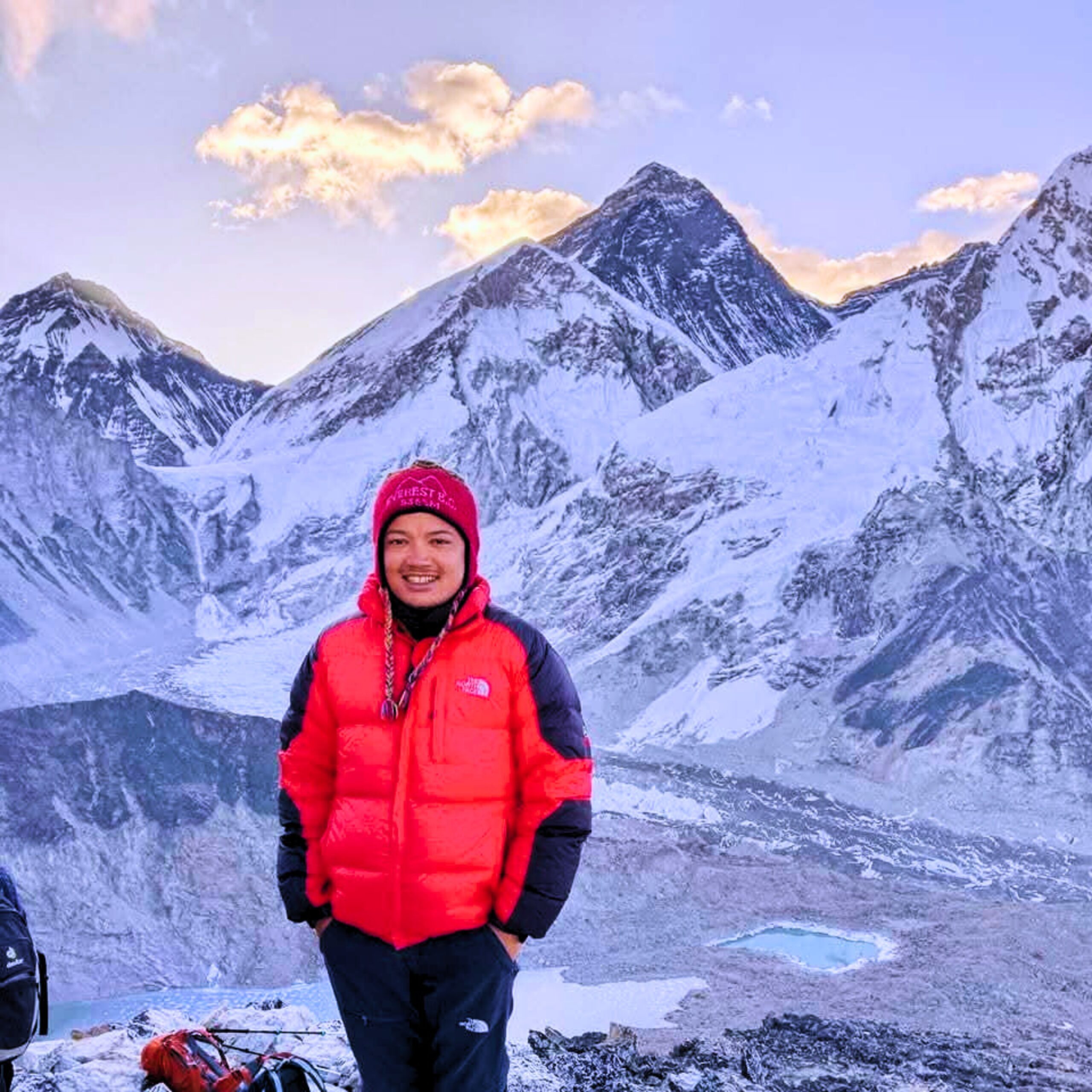
The day begins early with a hike to Kala Patthar, the highest point of our trek, located at 5,545 meters. From here, you’ll be treated to one of the most spectacular sunrise views on Earth, with Mount Everest, Lhotse, Nuptse, and many other towering peaks visible in their full glory. After soaking in the breathtaking views, we’ll descend back to Gorak Shep before continuing to Lobuche for an overnight stay. The descent allows us to retrace our steps and take in the changing scenery, while also preparing our bodies for the ascent of Lobuche Peak.
Today, we’ll trek from Lobuche to Lobuche Base Camp, where we will set up camp. Here, you’ll receive climbing instructions and safety briefings from our experienced Sherpas, who will help you prepare for the summit push. This is also a crucial acclimatization day, as you will rest and allow your body to adjust to the higher altitude. The camp is located in a stunning location, surrounded by towering peaks and glaciers, providing a serene environment to rest and mentally prepare for the challenges ahead.
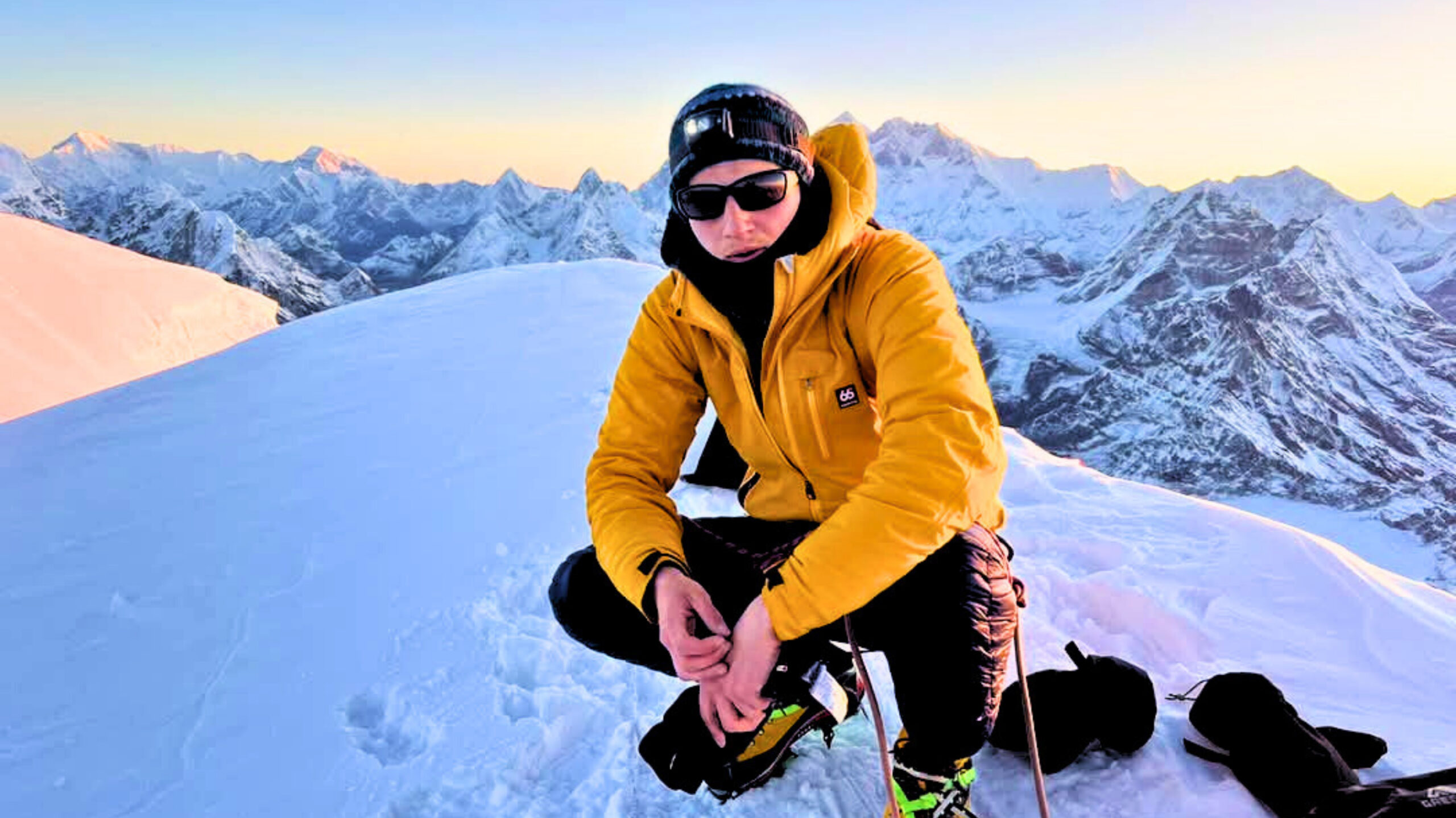
This is the day you’ve been waiting for – the summit push to Lobuche Peak. The ascent starts early in the morning as we navigate rocky terrain, glaciers, and use fixed ropes to climb higher. The climb is physically demanding but incredibly rewarding, as we near the summit and are treated to panoramic views of the surrounding peaks. Upon reaching the summit of Lobuche Peak, you will experience a profound sense of accomplishment, as the 360-degree views of Mount Everest, Lhotse, and Makalu are simply breathtaking. After celebrating your success, we will descend back to Base Camp for a well-deserved rest.
This day is reserved as a contingency day in case of unfavorable weather conditions or any additional acclimatization needs. If the weather is clear and the summit was successfully reached, you will have the opportunity to rest, explore the surrounding areas, or interact with the local Sherpa community. This flexible approach ensures that all climbers can fully enjoy the experience without feeling rushed.
After the summit, we begin the descent, trekking from Lobuche Base Camp to Pangboche, a peaceful village located in the Khumbu Valley. The trek takes us through scenic landscapes, passing through traditional Sherpa villages and offering a tranquil atmosphere to reflect on our achievements. In Pangboche, you’ll have a chance to relax and interact with the locals, immersing yourself in the Sherpa culture.
The trek continues as we descend to Namche Bazaar, passing through the village of Tengboche. Along the way, we pass through lush forests, cross suspension bridges, and enjoy more of the stunning Himalayan vistas. Upon arrival in Namche, you’ll have time to relax, explore the town further, and prepare for the final leg of the trek.
From Namche Bazaar, we begin the final leg of the trek, heading back to Lukla. This journey retraces many of the paths we took earlier, providing one last opportunity to soak in the stunning views of the mountains, rivers, and villages. Upon reaching Lukla, we’ll celebrate our successful expedition with the team, reliving the highlights of the journey.
After an early morning flight from Lukla, we return to Kathmandu, where you can relax and rest after your long journey. This is a day for reflection on the incredible journey you’ve completed and the remarkable sights you’ve experienced. The remainder of the day is at your leisure.
On your final day, you can enjoy some optional sightseeing or simply rest before your departure. Depending on your flight schedule, we will transfer you to Tribhuvan International Airport for your onward journey. With cherished memories of the Lobuche Peak Expedition, you will bid farewell to Nepal, having experienced one of the most extraordinary adventures of your life.
Autumn (late September to November) and Spring (March to May) are considered the best seasons for Lobuche Peak Climbing, along with the EBC trek. Both these seasons generally provide the highest summit chances i.e. about 90% mainly because the weather is more stable during these times and the route conditions are easier as compared to that of a winter or monsoon on this 6, 119, meter peak.
Indeed, Lobuche Peak can be scaled during the winter or monsoon seasons. However, the weather in the Khumbu region is quite unpredictable during these seasons. So, your dates, flights, and even trying to reach the top will depend on what the weather’s doing at that exact moment. We really don’t think you should try to summit Lobuche Peak during the monsoon or winter.
Now, about climbing Lobuche Peak: you actually can do it in winter or during the monsoon season. But here’s the thing, the weather in Khumbu can be a real toss-up then. summit attempts depend heavily on real-time conditions. Honestly, we don’t really suggest trying to climb Lobuche Peak in winter or monsoon.
The weather decides everything at 6,119 meters. Predictable weather means higher summit chances. Unpredictable weather means turning back at 5,900 meters with the summit in sight.
So picking the right season? Probably the most important decision after choosing your guide team.
Autumn light hits differently at altitude. Something about the post-monsoon atmosphere creates golden hour effects that last for actual hours. Everest at 6 am in October looks bronze and pink and impossible.
For the Sherpa people and Tibetan Buddhist communities, peaks are sacred, places with spirit, power, and personality. Locals see snow-draped mountains as gods. Living, breathing, abodes of protective deities, who decide whether climbers return home safely or don’t return at all. So before a team tries to stand on the top of Lobuche, Everest, or any other high Himalaya, they do what locals have done for generations: an ancient ritual, where they ask permission.
Most Lobuche pujas are performed at Lobuche base camp, lower monastery, or at a closely situated high camp, that is, where the team has stayed before the day of the summit. Monks invoke protection from mountain deities and chant mantras of old age. Spiritual trekkers connect while chanting a mantra. A senior lama or Shaman is the one who leads the ceremony. Everyone participates. Climbers. Guides. Porters. Kitchen staff. whose families have lived here for generations. They perform this old-age ritual to acknowledge they’re entering territory that doesn’t belong to humans.
You get to be part of a high-altitude ancient Himalayan ritual of a lifetime. Near the end, the team may receive a small blessing, such as a tika on the forehead or a sprinkle of holy water or grains. You can feel the high vibration of raw energies while on a ritual. A few people on the whole planet get the chance to experience it.
The ancient raw Himalayas do something to people. Have done for centuries. Will keep doing long after we’re all gone.
The difficulty level of Lobuche Peak climbing with the EBC trek is ranked moderate to challenging for physically prepared individuals willing to respect altitude, accept coaching on technical skills, and maintain mental determination when bodies rebel against continued effort. That elevation to 6,119m isn’t achieved in a single push. The itinerary chops it up into an achievable daily dose of about 400 to 600 meters of ascent, punctuated with potential acclimatization days. You have to walk 6–8 hours several days in a row on major uphill and downhill trails. You’re not going to some random 6,000-meter peak You’re climbing in the Everest neighborhood. It is well known for its beginner-friendly peak climbing tag. This mountain has been climbed by thousands with no previous mountaineering experience.
The highest point we reach is 6,119m above sea level. Lobuche Base Camp is located at approximately 5,100m, on the rocky moraine overlooking the Khumbu Glacier system. You would sleep at this place one night and the next morning move ahead to High Camp and then summit. Greater than anything in the Alps or the North American Rockies. High Camp goes even higher, about 5,700 meters. That High Camp altitude is higher than the peak of Kilimanjaro, the tallest point in Africa. Training: Hiking with a weighted pack at least 3-4 months in advance.
As a workout, stair climbing makes you stronger in the muscles that will give out first when you hit the Himalayan trails. Running builds cardiovascular capacity, though actual mountain hiking prepares you better psychologically. Prior trekking experience at altitude helps enormously, even something like the Annapurna Circuit or the Langtang Valley trek completed previously makes the Lobuche Peak climbing feel less shocking. Technical skills get taught during the expedition itself by guides who’ve climbed this route dozens of times.
The infrastructure supporting climbers. Experienced Sherpa guides who read mountain conditions instinctively. Fixed ropes installed fresh each climbing season. Proper acclimatization schedules preventing most altitude sickness. Tea houses and lodges providing actual beds and cooked food during the approach trek. High Camp supported by porters and cooking staff. Rescue helicopters positioned within a 30-minute flight distance.
The distinction often comes in the quality preparation, acclimatization, discipline and mental toughness and not so much natural athletic ability. The challenge remains real. The support system makes that challenge manageable for prepared individuals. Show up ready. Listen to your guides. Move when they say move. Rest when they say rest. With proper pace, the summit becomes genuinely achievable.
Lobuche Peak climbing is often called beginner-friendly Himalayan peak. Lobuche Peak actually welcomes prepared fit beginners who put in the training work before showing up. If you can hike uphill for 5-7 hours carrying a daypack, you’re in a reasonable starting baseline. That’s where preparation begins, not where it ends. The summit demands more than the baseline. You don’t need speed. You need repeatability. Mental fitness honestly matters as much as physical fitness.
The physical side splits into a few different categories, and each one matters. Cardiovascular endurance comes first. Your heart and lungs need to work efficiently for extended periods. We’re talking 6-8 hours of walking daily during the trek portion. Summit day pushes more than 9-10 hours of continuous effort. Leg strength shows up as the second major requirement. Quads. Hamstrings. Calves. Glutes. Knee stability matters hugely because the terrain is uneven everywhere. Ankles need conditioning, too. Loose rocks and glacier moraines want to twist ankles that haven’t been trained for lateral stability. Strong legs prevent injuries. Core strength gets overlooked by people preparing for this climb.
We provide the supplies. Guides handle logistics. Cooks prepare meals at camps. Porters carry the heavy stuff. We provide equipment support, safety protocols, and everything external. What we can’t provide? Your fitness. Your preparation. Your mental readiness. The months before departure determine which experience you’ll have up there at the summit of Mount Lobuche.
Start 3-4 months before your departure date, minimum. First month focus on building base fitness. Hiking twice weekly. Stair sessions twice weekly. Strength training twice weekly. Second month increase volume. Longer hikes. Heavier pack. More stairs. Add some intensity to strength sessions. Third month, peak your training. Longest hikes. Heaviest comfortable pack weight. Most challenging stair sessions. Fourth month taper slightly before departure.
Here is a simple 16-week training plan for Lobuche Peak climbing.
Week 1-4
Week 5-10
Weeks 11–14
Weeks 15–16: Taper and arrive fresh
Imagine Mount Everest (8848.86m): the world’s highest peak, Lhotse (8,516m): the world’s fourth highest mountain, Cho Oyu (8,188m): the sixth highest peak, and a bunch of other Himalayan giants of Everest as your first view of morning, after you wake up and unzip the tent from the base camp of Mount Lobuche.
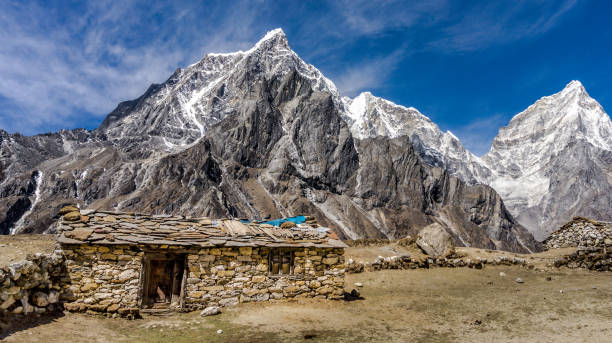
One of the underrated joys of a Lobuche Peak climb via Everest Base Camp is that your accommodation changes with the landscape and altitude. This is an organized, professional mountain operation. You start with your peak climbing journey with a scenic 30-minute flight from Lukla. The first chunk of your peak climbing journey keeps you in traditional Sherpa villages, Phakding, Namche Bazaar, Tengboche, Dingboche, and Gorakshep. These old-school tea houses are run by generations of Sherpa families, who call Everest their home. You get access to a hot shower, an attached bathroom, and cozy accommodations in lower villages only. But the facilities are limited by the altitude. Up high, you sleep in a climbing camp. Going via EBC means you walk the same corridor of valleys and viewpoints that have pulled legendary climbers into the Khumbu for decades.
Your guides and porters carry generations of high-altitude expertise running through their veins. Once we move onto Lobuche Peak Base Camp at 5,100 meters, you’ll sleep in camping tents instead of teahouse rooms. You’ll have a proper camp setup. A warm sleeping tent for rest, if you do proper layering. Professional guides and porters don’t just carry gear; they build a working camp in high-altitude terrain. Your guides handle route decisions and safety systems. Porters support the logistics that make the climb possible. Hot food and hot drinks are luxuries up high. Your expedition team sets up a proper camp. Tents. Sleeping tents for climbers. A dining tent where everyone gathers. Kitchen tent where the magic happens. With cook. Your guides handle everything at base camp. Tent setup. Gear checks. Weather monitoring. Acclimatization schedules. Oxygen supplies. Kitchen staff at camps ensure you’re fed and hydrated. You focus on resting, eating, and hydrating. We handle all the logistics.
The accommodations up here at the base of Mount Lobuche aren’t five-star. But the experience? Absolutely priceless, which no money can buy.
Wi‑Fi is usually available in the lower mountain villages on the way up. The facility becomes less reliable and slower as you gain altitude. Some lodges have their own network. Many use prepaid services like Everest Link. After Gorak Shep and around the EBC side trip, connectivity can feel hit-or-miss. We recommend you to carry an NTC SIM. The network connectivity of Nepal Telecom (NTC) SIM card is more reliable than that of the Ncell SIM. Wi-Fi cards are now available at Everest Base Camp via Everest Link extreme internet.
Some Everest teahouses charge a few hundred Nepali Rs as a charging fee, a hot shower or Wi-FI fee. You’ll usually charge in the dining room or lobby. A lot of tea houses rely on solar power, which means power is limited. In lower villages, you can get attached bathrooms. Hot showers are more common down low. Some places feel surprisingly comfortable and luxurious. If you are craving for luxury beneath the world’s highest mountain, Mount Everest (8848.86m), the EBC Luxury trek is perfect for you. There is no electricity or Wi-FI after passing EBC. We highly recommend to bring powerbank with high power backup. As you climb higher, facilities get simpler. Showers become limited or extra-costly.
The highest altitude you’ll gain while summiting Mount Lobuche is 6,119m. Bodies react weird and different at altitude. A good policy that supports evacuation and treatment removes the pressure to push through when your body is waving red flags. We strictly not recommend summiting Mount Lobuche Peak without proper high-altitude medical and evacuation coverage.
Many travel policies quietly stop covering you above a certain altitude. Check your policy wording carefully. If your policy caps at 5,000 m, it won’t cover the higher altitude while summiting Mount Lobuche, 6,119m. You need altitude coverage of a minimum 6,500m. Getting airlifted from high altitude in the Himalayas isn’t like calling an ambulance back home.
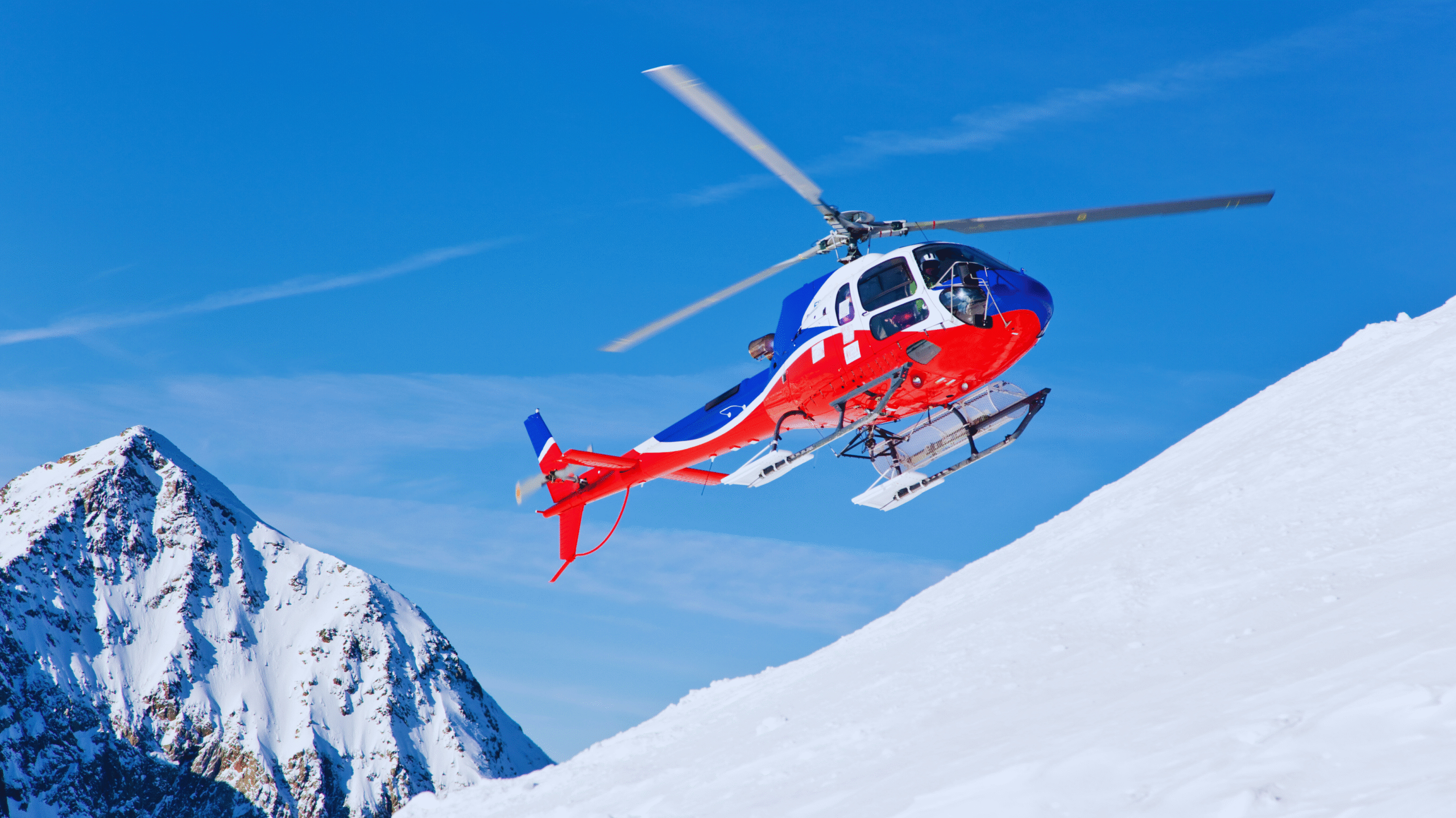
There are specialized helicopters, limited weather windows, a trained few high altitude pilots, and expensive operations. Cost of an average helicopter rescue from the Everest region? Around eight to fifteen thousand US dollars. Depending on location, conditions, how many trips needed. Your insurance needs to explicitly cover helicopter evacuation, so that it covers helicopter rescue.
Did you know you get a refund of your money back if the trip is cancelled or interrupted? But, only if your policy covers trip cancellation or interruption in your insurance
Good policy reimburse:
Sitting at 6,119 meters, this peak belongs to the Everest massif. Same geological family. Same ancient rock system. Same dramatic ice formations that have been pulling climbers into the Khumbu for decades now. Standing on Lobuche summit, you’re staring directly at four of the planet’s highest mountains. Everest. Lhotse. Makalu. Cho Oyu. All eight-thousanders with 16 other high Himalayas of Everest’s family. You journey via two base camps, Everest Base Camp and Lobuche Base Camp, in one trip. Along the way at lower villages, you stay in traditional Sherpa teahouses. As you push higher and closer to the mountain, the trip shifts into a true expedition feel.
From the higher viewpoints, the alpine Himalayan panorama opens wide and keeps opening: Everest (the world’s highest mountain) and Lhotse (the world’s fourth highest) rising above the Khumbu like a skyline, with Cho Oyu (8,188m). Nuptse’s massive wall catches morning light first. Pumori glows pink. Ama Dablam, that iconic pyramid, sits perfectly framed against endless blue. Changtse reaches into Tibet and other Himalayan giants. On a clear day, the range seems to roll on and on, with distant ridges reaching toward Tibet.
You get the social, cultural rhythm of a Himalayan teahouse trek and the focused, high-mountain vibe of a camping climb, all at Lobuche Peak with EBC.
It requires certain permits and documents to trek or summit any peak in Nepal. Every checkpoint along the Khumbu route has someone checking papers. Missing even one document may create a problem. The government tracks who enters climbing zones, monitors environmental impact, collects fees that fund conservation efforts, and locals.
These are the permits and documents that are needed for Lobuche Peak Climbing with EBC. It’s better if you carry hard copies of possible documents.